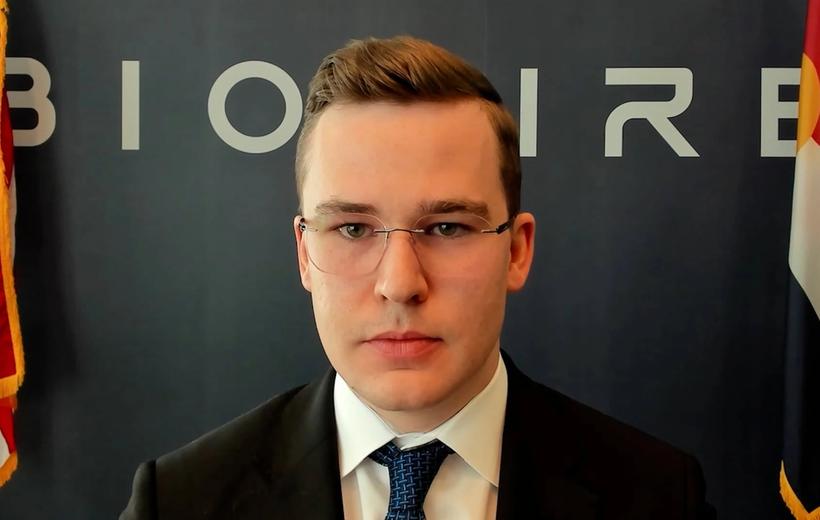
Biofire continues to support gun owners’ choice with guest testimony at the Massachusetts Special Legislative Commission on Emerging Firearm Technology
April 10, 2025
“We are proud to offer the Biofire Smart Gun as a new option for consumers. And we firmly believe that personalized firearm technology should remain a choice for responsible gun owners, one innovative solution among many. Mandates of personalized firearm technology, however well-intentioned, backfire by unintentionally stifling innovation and creating a backlash against adoption of the technology that such mandates intend to promote. I want to be very clear here: The Americans who choose our technology do so trusting that we support their freedom of choice. The existence of the technology, and our ability to develop it, rests upon that foundation of trust. Our goal is to work alongside the firearms community and policymakers to ensure this technology is adopted voluntarily because it proves its value, not because it is forced.”
On April 10th, 2025, Biofire CEO and Founder Kai Kloepfer gave guest testimony virtually on behalf of Biofire at the Massachusetts Special Legislative Commission on Emerging Firearm Technology. Kai reaffirmed Biofire’s stance against mandates that restrict gun owners’ right to choose the firearms that best fit their situation.
This follows Biofire’s clear commitments and previous action, including filing an amicus letter with the US 9th Circuit Court of Appeals in connection with the Boland v. Bonta litigation, which challenges the constitutionality of the California Unsafe Handgun Act (the “UHA”).
Biofire continues to be actively engaged with owners, advocates, regulators, and lawmakers across the country to build consensus-driven solutions that enhance safety. The Biofire Smart Gun has been added to Massachusetts’, Maryland’s and California’s handgun rosters showing recognition of Biofire’s efforts to advance the options of gun owners to choose the safest firearm for them.
DOWNLOAD KAI KLOEPFER’S GUEST TESTIMONY HERE.
View the live testimony.
GUEST TESTIMONY OF KAI KLOEPFER
FOUNDER AND CEO, BIOFIRE
The 194th General Court of the Commonwealth of Massachusetts
Special Legislative Commission on Emerging Firearm Technology
Good afternoon, Chair Moore, Chair Lipper-Garabedian, and members of this Commission. Thank you for the opportunity to speak today. My name is Kai Kloepfer, and I am the Founder and CEO of Biofire, the leading developer of personalized firearm technology.
Firearm-related causes took the lives of 47,000 Americans in 2023 and impacted, through injury and other harms, millions more. Around sixty percent of these deaths are the result of suicide and accidents, rather than violent crime.[1] Unauthorized access to firearms is a leading cause of death among children and teens in the United States.[2] Children and teens are particularly vulnerable because they are curious, impulsive, and lack awareness of the dangers posed by improper use of firearms. Everyone can agree that reducing unauthorized access to firearms is an important part of tackling this broader challenge.
Equally clear is that firearms are a permanent fixture of the culture of the United States and are protected by well-established Constitutional law. More Americans are purchasing firearms each year for personal protection. Sporting, competitive shooting and other firearm-related activities are core to American culture.
The question before us, as citizens, as neighbors, and as parents, is how to reconcile our rights with the safety we all deserve? How do we reduce tragic accidents among the public, while also preserving their freedom? It is poignant to be addressing this topic with public servants in Boston, a city rich with the history of wrestling with these very ideas.
Biofire’s mission is to develop a technology-driven and pragmatic approach to address some critical aspects of this public health issue while simultaneous preserving the freedoms of American citizens. I know that technology is not a panacea – but innovation has an important role to play, and so I want to thank you again for welcoming our voice to the table. Before I delve deeper, let me state Biofire’s core policy position clearly: we oppose any law that would mandate, whether de jure or de facto, the use or sale of personalized firearm technology. We aim to develop technology that delivers choices, not restricts them.
I have been working on personalized firearm technology for 13 years and founded Biofire in 2016 with the aim to apply America’s unique strength in technology to the uniquely American challenges around firearm violence, especially those involving children and teens. I spent some of these years at MIT before dropping out in 2018, driven by an urgent need to tackle this issue full time. Biofire is the only venture-backed company in the firearms space. We have raised over $50 million from some of our country’s top investors, and this funding has enabled us to build a world-class team with experience in defense, aerospace, medical devices, automotive, and firearms. We’ve assembled this talent to focus on developing the Biofire Smart Gun.
We are proud to be the pioneers in this space, but we are also keenly aware of the responsibility that comes with introducing a new class of firearm. From the beginning, our focus has been on keeping gun owners and their families safe. This requires a highly reliable, instantly accessible firearm for self-defense, and, just as importantly, a robust safety system our customers can trust to prevent unintended use.
Biofire has made significant progress addressing the technical challenges of creating a firearm that is both instantly available for its owner while simultaneously always locked from unauthorized use. We officially unveiled the Biofire Smart Gun in April 2023 and began taking pre-order reservations from the public at that time. The public interest in purchasing a Smart Gun is substantial. We’ve received thousands of pre-order deposits from customers across the country. We see real, present demand for personalized firearm technology from all fifty states. We devoted last year, 2024, to extensive final testing and limited beta production. This year, we are ramping to full production to fulfill those orders.
Our Smart Gun has undergone rigorous evaluation to meet all applicable safety requirements for handguns. As of early 2025, the Biofire Smart Gun has been approved for sale in all fifty states, including being added to the official handgun rosters in Massachusetts, California, and Maryland. In addition, the Smart Gun is approved in California as a Firearm Safety Device, meeting the stringent requirements for equipment intended to keep firearms secure from unauthorized use. The Biofire Smart Gun represents the first time that a firearm itself has also been certified as a Firearm Safety Device by the California Department of Justice.
We are proud to offer the Biofire Smart Gun as a new option for consumers. And we firmly believe that personalized firearm technology should remain a choice for responsible gun owners, one innovative solution among many. Mandates of personalized firearm technology, however well-intentioned, backfire by unintentionally stifling innovation and creating a backlash against adoption of the technology that such mandates intend to promote. I want to be very clear here: The Americans who choose our technology do so trusting that we support their freedom of choice. The existence of the technology, and our ability to develop it, rests upon that foundation of trust. Our goal is to work alongside the firearms community and policymakers to ensure this technology is adopted voluntarily because it proves its value, not because it is forced.
I’d like to give an overview of the Biofire Smart Gun itself – what it is, how it works, and why it’s unique.
The Biofire Smart Gun is a 9mm semi-automatic handgun designed primarily for home defense. We chose to prioritize home defense over other use cases – such as concealed carry – because it is the critical need. Many Americans purchase their first firearm for home defense and are at higher risk of mistakes compared to more experienced firearm owners in other categories.
The home is also where children and teenagers most often have inadvertent access to firearms. Millions of American children live in homes with loaded and unsecured firearms,[3] and tragedies all too often occur when a child or teen accesses a gun. Furthermore, nearly 95% of stolen firearms traced by the ATF are stolen from private citizens,[4] often from the home.
The Biofire Smart Gun is designed, engineered, and manufactured from the ground up specifically to incorporate biometric authentication as a first-class feature. This differs substantially from prior approaches that attempted to retrofit electronics onto existing firearms or took an off-the-shelf mechanical firearm design and attempted to tweak it with technology. Our clean-slate approach is required to create a product that is reliable both as a safety device and as a firearm. The Smart Gun’s safety features are not add-ons; they are built into the very core of the firearm. This has allowed us to deliver on the key premise of a Smart Gun: a home-defense handgun that feels and functions like a traditional, high-quality pistol for the authorized user, yet is always locked for anyone else.
The Smart Gun unlocks almost instantaneously when needed by an authorized user. This functionality is powered by our proprietary Guardian Biometric Engine – a redundant biometric authentication system integrating fingerprint and facial recognition sensors – that, together, robustly authenticates a user across the wide range of conditions incumbent to the real-world use of firearms. In practice, this feels seamless – the user simply picks up the Smart Gun as they would any other handgun. The use of biometrics means that there is no password to remember. There is no pin code that a child can oversee. There are no physical keys that can be misplaced or stolen. And, importantly, there is nothing that can be taken from the owner in order to use their handgun. Critically, if anyone other than an authorized user picks up the weapon, it remains locked and unable to fire.
By default, the firearm is always in a safe, locked state except when it is being held by an authorized user. Additionally, the moment the firearm leaves an authorized user’s hand – for example if the user sets the firearm down or it is taken from them by an assailant – it automatically disarms without any affirmative action required by the owner. It is worth noting that while our sophisticated electronics and biometric authentication mechanisms essentially act to convert the Smart Gun into a traditional firearm for the authorized user, it is this automatic deactivation upon release that is the core safety feature in preventing unauthorized or accidental use. It removes much of the human error from the equation of safe gun storage.
Under the hood, Biofire has created the world’s first electronic fire control system in a handgun. This “fire-by-wire” approach, where there exists no mechanical connection between the trigger and the firing pin, enables the Smart Gun to arm and disarm extremely quickly and reliably. The experience of using the firearm remains familiar for an authorized user, as the user pulls the trigger, the Smart Gun makes a sub-millisecond fire control decision based on if the user is authenticated. This approach also greatly enhances the robustness of the safety mechanism against attempts to bypass it. There is no “lock” or other mechanism that can be removed or tampered with to convert the Smart Gun back into a traditional firearm, as the electronic fire control system is an integral, and specialized, part of the function of the firearm.
Beyond the core safety features, Biofire takes the privacy of its users extremely seriously. All biometric data is stored locally on the firearm in encrypted form. This encryption is zero-knowledge, which means that no one, not even Biofire, has access to the encryption keys used to protect the data as they are generated securely within the Smart Gun itself. Additionally, the Smart Gun does not have any wireless connectivity – there is no Wi-Fi, Bluetooth, GPS, or, broadly, radio frequency capability in the firearm itself. This closed-system approach protects the owner’s information and ensures the Smart Gun cannot be accessed remotely.
Finally, the Biofire Smart Gun supports up to five authorized users per firearm. The owner can add additional trusted users – for example, a spouse, an adult family member, or a close friend. This decision is made by the owner, and any changes require the owner’s biometric information to confirm the addition of a user. This flexibility allows each family to decide who should have access to their firearm. If the situation changes, the owner can instantly revoke access. This is analogous to having multiple keys to a safe – and the owner decides who holds the keys.
In summary, the Biofire Smart Gun is a fully integrated, sophisticated firearm that marries state-of-the-art electronics and software with high-quality mechanical performance and reliability. For an authorized user, it functions just like a traditional 9mm pistol – they can use the Smart Gun with no special steps needed beyond picking it up and pulling the trigger. For anyone else, it is a heavily engineered paperweight.
I want to now turn to Biofire’s perspective on policy.
As the only company that is currently offering a commercially available personalized firearm, we have a unique viewpoint on how personalized firearm technology and emerging firearm technologies like ours should be contemplated by legislation and regulation. In short, Biofire opposes any government mandates requiring the use, sale, or exclusive availability of personalized firearms, expressly or otherwise. We instead support approaches that incentivize voluntary adoption without infringing on consumer choice or the broader firearms market.
Let me outline a few key points underlying our position:
First, let us be clear, any mandate of personalized firearm technology is a de facto gun ban.
Biofire is currently the only manufacturer with a viable personalized firearm on the market, and we currently produce a single model, which is highly optimized for home defense to the exclusion of other use cases. In comparison, the US commercial firearms market today comprises thousands of models of firearms from a competitive group of manufacturers, with each model competing for a different use case and niche. This is how the firearms industry, like any industry, addresses the wide range of different ways that Americans own and use firearms.
Any law that required all, or any subset, of gun purchasers to buy only personalized firearms would force consumers into a very narrow selection – currently one model – which is, as compared to the thousands of models of traditional firearms, highly unlikely to meet their needs. This also places impossible and existential expectations on any developer of personalized firearm technology. While we are confident that we have built the best handgun possible for home defense, it is truly impossible for us to build any single model of firearm that can meet every use case with the same degree of care we have paid towards home defense. We are one manufacturer of one type of product in a diverse market with many types of products. Mandating Smart Guns would be like mandating that the only vehicle available for purchase in America is a Tesla Cybertruck – a position jarringly disconnected from the needs of the American public.
Additionally, the Biofire Smart Gun currently retails for $1,500, a premium priced product. While we have worked hard to keep our cost as affordable as possible, investing millions into cost reduction initiatives, a Smart Gun contains hundreds of dollars of advanced electronics, sensors, and optics not present in a traditional firearm. This places the Biofire Smart Gun, at least for now, out of reach of many Americans who have very real and present need to own a firearm.
Finally, from a very tactical perspective, while Biofire is rapidly scaling our manufacturing capacity we are a single early-stage company with limited production capacity. No company today, including Biofire, is prepared to supply an entire state’s demand for handguns with a single product line. A mandate would likely leave law-abiding citizens with no available gun to purchase at all, the literal definition of a gun ban. This zero-sum scenario is one major reason we oppose mandates – it pits new technology against old in a way that is counterproductive.
This is not just opinion, we have seen this play out in practice. A previous personalized firearm mandate law enacted 2002 in New Jersey backfired so spectacularly that it was effectively repealed by its sponsors in 2019. During those intervening years, rather than spurring innovation as intended, that mandate froze the personalized firearm space: it antagonized gun owners who feared losing access to traditional firearms and deterred investors from funding personalized firearm development.
Even the most ardent advocates now agree that the New Jersey approach was counterproductive. Mandates will stifle innovation and investment in our young industry, just as the prior ones did. We are not here to repeat history, especially at a time where the Biofire Smart Gun is gaining rapid traction with the American public. No mandates of personalized firearm technology are in place today, and Biofire will be first in line to fight against any future mandate of personalized firearm technology.
Second, personalized firearm technology is complex, expensive, and not easily replicated.
Biofire has deployed the best of America’s technologists, engineers, and designers for over seven years towards the development of this product, at a cost of tens of millions of dollars. This is not akin to designing a biometric safe using off the shelf components from China; we have deeply integrated a custom miniaturized computer, sensor suite and novel electronic fire control system into a firearm – while ensuring that it will function as required in the extreme conditions inherent to this use case.
The high development cost and technical expertise required mean that no traditional gun manufacturer has yet developed a similar product, in large part because of these significant financial and engineering hurdles.
If lawmakers mandated that all guns be personalized, you’d effectively be handing a monopoly to one small company until others catch up. That’s not healthy for competition, the American public, or fostering innovation in safety technology. Furthermore, there’s no guarantee that other manufacturers could quickly produce a safe and reliable personalized firearm even if compelled – it’s far from trivial. A mandate could thus stall the entire firearms market waiting for others to develop compliant products.
We believe a better approach is to allow this technology to mature and prove itself in the market on its own merits. In time, if personalized firearms from multiple manufacturers become available and cost-effective, more consumers will opt for them voluntarily. Innovation needs room to breathe.
Third, the Biofire Smart Gun is not a panacea for every issue related to guns, nor is it intended for every use case. We are the first to acknowledge that our product does not render traditional firearms obsolete, nor will it prevent all forms of gun violence. It is a specific solution aimed at a specific problem set: unauthorized use, particularly in the home.
We caution against viewing personalized firearms as single solution for many broader issues. For example, our solution does not inhibit individuals who are legally able to purchase firearms from buying a weapon to do harm. However, personalized firearms are one of very few options identified by public health experts as likely to reduce child accidents and teen suicides in households that own firearms. These are situations where the firearm is being used in a way that no gun owner ever intends, and thus a product-based approach like the Smart Gun is a good fit.
We are laser-focused on making our firearm the best option for people who want an extra layer of safety at home. For other responsible gun owners who prefer traditional models, that is absolutely their right – and we firmly support firearm owners’ freedom of choice. In fact, I believe offering the Smart Gun as a voluntary choice is what will make the technology successful in the long run. Americans have a clear propensity to embrace innovation when it’s not forced upon them. Mandates or blanket bans only breed resentment or skepticism, whereas demonstrating the value of the product will earn trust over time.
If mandates are not a productive approach to accelerate adoption of personalized firearm technology, what are some approaches that could bear fruit?
In states, like Massachusetts, where there is public and political momentum around studying and promoting personalized firearm technology, incentive programs could be a positive way to accelerate voluntary adoption. For instance, states might offer tax credits, rebates, or other financial incentives for those who purchase a personalized firearm for home defense. These incentives could offset some of the premium associated with this novel technology and enable a wider range of Americans access to personalized firearms, where they might otherwise only be able to afford a traditional firearm. This could, in particular, have an outsize impact in some of our most vulnerable communities.
When citizens are considering a product like a firearm, where there are lives at stake, they look to trusted experts for advice. States could engage the firearm experts they already employ in law enforcement and public safety to assist with independent evaluation and trust building around high-quality personalized firearms.
Updating safe storage laws to expressly include personalized firearms, a safe storage technology clearly superior to any other on the market, would also incentivize adoption and increase compliance with these laws.
Instead of mandates and coercion, we support a market-driven approach supplemented by thoughtful incentives. Let the best solutions rise to the top because people want them and because they are better than the competition, not because they’re the only legal option. Any proposed incentive structure must preserve consumer choice and not penalize those who opt for traditional firearms.
I am confident that as our Smart Gun continues to prove itself – as early adopters have positive experiences and as independent experts vet its quality – more and more Americans will choose to adopt this technology. That organic growth is important. It sends a signal to other manufacturers that there is a viable market here, which will encourage competition, investment, and further innovation. Nothing would slow that progress more than a premature mandate that causes backlash or discourages others from investing in R&D.
Before concluding, let me clearly address a specific concern we often hear from our customers: the fear that personalized firearms might be used by policymakers as a tool to restrict access to traditional guns. Biofire is understandably very sensitive to this concern. I want to state unambiguously that we do not support using our technology as a pretext to ban or confiscate other firearms. We have and will continue to oppose any attempt to politicize our product or personalized firearm technology more broadly.
As one example, we have not and will not submit our Smart Gun to New Jersey’s personalized firearm roster for precisely this reason. Under New Jersey’s personalized firearm roster law, the moment a personalized firearm is officially certified, every gun store in the state would be required to stock it, which is an undue burden on retailers and could engender political weaponization of our technology.
We’re building positive long-term relationships with the firearms industry, the dealers, instructors and enthusiasts who our customers rely on for advice, training and service. The industry is excited about the Biofire Smart Gun and willing to judge it on its own merits. Forcing arbitrary additional administrative burdens on gun stores doesn’t incentivize them to support our technology; it does the exactly the opposite.
In closing, I want to reiterate that Biofire’s goal is first and foremost to advance the development of firearm safety technology. We are the vanguard, tackling the challenges of the frontier to materialize new, better choices for American gun owners. This goal is not realized by mandating adoption of a premium technology that is limited in supply and not intended for every situation.
We believe this technology can save American lives lost every day to gun violence, and we’re bringing it to market in that hopeful spirit. These are not statistics in a CDC database, these are your community members, your neighbors, even your family, being impacted by the very real costs of gun injury. We strongly believe the success of this technology relies on earning the trust of gun owners and the public, not on government edicts that turn personalized firearms into a political football. Smart Guns must stand on their own merits as a safety innovation.
Biofire stands ready to work with policymakers, law enforcement, public health experts, and, more broadly, the firearms community to develop sensible incentive programs that will encourage the adoption of personalized firearms in a way that respects Americans’ rights and choices. Let’s advance safety and innovation through collaboration, not coercion.
I appreciate the opportunity to provide Biofire’s perspective and experience to this Commission, and I’m happy to answer any questions you may have. Thank you.
[1] CDC WONDER, 2023.
[2] CDC Morbidity and Mortality Weekly Report, December 15, 2023.
[3] Miller M, Azrael D. Firearm Storage in US Households With Children: Findings From the 2021 National Firearm Survey. JAMA Network Open. 2022 Feb 1;5(2):e2148823. doi: 10.1001/jamanetworkopen.2021.48823. PMID: 35191973; PMCID: PMC8864510.
[4] US ATF National Firearms Commerce and Trafficking Assessment (NFCTA) - Volume 4, Part II.