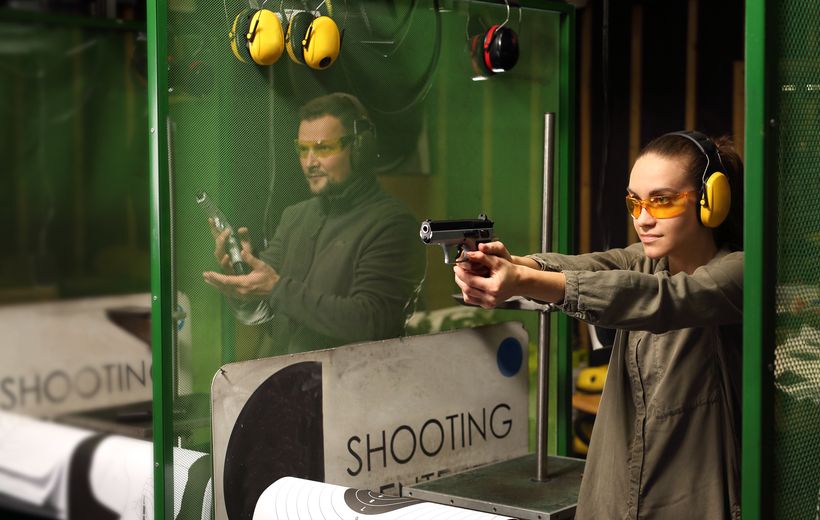
Firearm Range Etiquette
May 23, 2023

By Jennifer L.S. Pearsall
This isn’t some forks on the left, spoons on the right, Miss Manners type of thing. It’s about keeping everyone safe.
Firearm ranges are usually found in one of three ways: 1) they have a range safety officer (RSO) physically on the range for the duration of a shooting period or competition; 2) the range and its safety are monitored by the participants on the line; or 3) the range has close-circuit video monitoring. Here’s what to expect from each.
RSOs on the Range
You will most often find a range with an RSO as a constant, physical presence at top-end facilities, both indoors and out, that have a full complement of amenities such as private VIP lounges, food and beverage services, and event hosting. These businesses have worked to be “destination” ranges that draw not just a steady stream of local patrons but tourists and other visitors to the area who make a point to enjoy all these ranges have to offer. RSOs will also be present on all stages or shooting lines of various shooting competitions and at special events, clubs, and ranges that are open to the general public.
There’s really only one thing you should know about an on-range RSO: Their word is law. If they tell you to do something, do it and ask questions later. If they tell you there’s a cease-fire, you stop firing now, not after you finish off the last three shots in your magazine. If they tell you to step back three feet from the firing line and that someone is going downrange to make a target carrier repair, do not take your range bag or gun or ammunition or anything else with you, and don’t check on your stuff or organize it while such a command is in effect. And, if an RSO asks you to pack up your gear and leave the range, follow their instructions and do it. You can have the conversation about why once you’ve left the range.
If it sounds strict, well, it is. It has to be. The RSO monitoring a firing line of multiple shooters is there solely to keep everyone safe, period. That person sees things you can’t see because of where you are on the line, such as when someone (maybe even you) gets lax about where their muzzle is pointing, a finger inside the trigger guard during a holster draw, a premature discharge that puts a hole in the range’s drop ceiling … . For those who are chronically careless and unsafe—it happens, just like there are chronically careless and unsafe vehicle drivers—the RSO is responsible for removing that person from the range.
RSOs are in charge of issuing the commands to cease fire, unload and step back from the bench, permission to reload and get ready, and the one we all love to hear, “Range is hot,” meaning you may proceed to fire. Such commands are necessary on bare-bone outdoor ranges so that shooters may go downrange to retrieve and reset targets safely, on any range so that a person can take care of a malfunctioning gun in such a way that others on the line remain safe, and so that repairs can be made to target holders, among other reasons.
RSOs working competitive shooting matches and tournaments have the same job—keep everyone safe. You may find such an RSO working an individual stage of an action-shooting sport, in which case they may also be the person holding the start/stop timer or activating a clays trap. These same RSOs are also multi-tasking, keeping an eye on the members of the squad on deck waiting to take their turn, or overseeing a line of precision target shooters, issuing commands as needed to start and stop timed firing sequences and effect the lowering and raising of automatic targets. In other words, such RSOs have a lot that requires their attention, so you will find them serious and focused on their duties.
The other thing you need to know about an on-range RSO is that they are there to help. Have a jammed gun? Set it on the bench with the muzzle pointed downrange and ask them to help you clear it. Having trouble loading a magazine? Ask them to help—and don’t be surprised when they tell you there’s a great magazine loader available in the retail store.
You can help an RSO do their job as well. They are, by and large, just one person watching several people at one time and, unlike your mother, they do not have eyes in the back of their heads. If you see another person on the line whose actions are unsafe, set your gun down, grab the RSO, and tell them about the incident. You are not being a snitch, and no one (except maybe the person with the problem, if they’re going to be a jerk about these things) will ever think badly about you for pointing out a safety problem.
Every Shooter is a Range Safety Officer
There are tons of ranges that don’t have full-time, always-on-range RSOs. When it comes to firearms, that may seem a questionable practice, but the truth is most people who handle firearms, once they have the safety basics down, understand that safety on the range is their responsibility, the responsibility of the person next to them, and the responsibility of the person 10 lanes down.
Speaking as a firearm owner of more than 30 years and as someone who’s hunted all over North America and shot on ranges big, small, luxurious, and hard-scrabble across the country, I can tell you this: We monitor each other. None of us with even a modicum of experience handling firearms have any problem helping another person on the firing line correct their actions or asking them to leave the range if their behavior is egregious. By and large we do it politely but firmly enough to get your attention and take the situation seriously, just as someone corrected our flawed handling when we were starting out. Every single one of us has made mistakes as we learned how to shoot, and you’re going to make them too.
CCT and Video Monitoring
You may come across indoor ranges (and some outdoor ranges) that use CCT or video monitoring of their shooting lanes. It’s a practical way to keep an eye on things when a full-time, always-on-range RSO is unavailable or isn’t an economical option for the business. It’s also a smart way to keep an eye on rental guns coming and going from pro shops or catch the occasional thief pilfering a cleaning kit, holster or other piece of gear from the retail store before they hit the range. The drawback regarding safety monitoring is that it’s kind of like having a “Lifeguard on Duty” sign up, but the lifeguard is at the ice-cream shack hamming it up with the pretty girls: He’s got an eye on the water—some of the time.
It's unlikely a range with this kind of setup has someone watching the cameras full time. More likely, the counter staff or a couple of back-office people are glancing at the monitors periodically as they go about waiting on customers, stocking shelves, and performing other tasks.
Such setups can and should be viewed as a safety asset: Some eyes on an active shooting line are better than no eyes. But the reality is that just as in the outdoor range or private gun club that completely lacks an on-range RSO, you and every other shooter on the line are responsible for your safety and the safety of those around you. If you see something, help the person correct the problem. If it’s a big problem, wave at the cameras for attention and then exit the range and grab a staff member who can make it right. And no matter whether it’s the person in the lane next to yours or the full-time RSO, take what we say in the manner in which it’s offered and be nice about it. It’s far better to thank the person who reminded you not to sweep your toes as you struggle to rack the slide on your pistol than it is the EMT who has to come stop the bleeding.