Firearm Safety—Making Good Habits Perfect Habits
May 9, 2023

By Jennifer L.S. Pearsall
Your first class on firearm safety and handling does not make you a person who safely handles firearms. Getting there is about making it all a habit.
I started my career in the firearm industry at a retailer and indoor range in Northern Virginia. I worked at that store back in the early 1990s, and over my nearly eight years there as the sales manager, I developed what I call the “driver’s ed” approach to helping people new to guns gain a better, more thorough understanding of firearm safety than the safety rules posted at the range would ever provide them. Here’s how it works.
From Mental Checklist to Automatic Performance
Whether you’ve taken a first-time shooting instruction class or are preparing to, what you’ll learn there is not a one-and-done deal. Safe firearm handling is really about acquiring a practiced set of good habits that, over time, will become ingrained and performed automatically. When I had a person new to firearms at my sales counter, I would go over the same basic rules we talked about in the last column:
- Treat every firearm as if it was loaded, every time you touch one.
- Always keep your firearm pointed in a safe direction.
- Never point a firearm at anything you do not intend to destroy.
- Keep your finger off the trigger until you’re ready to fire.
Those basics seem simple enough to grasp, but when you’re considering making a firearm part of your daily life, whether for target shooting, home defense, or concealed carry, they become a much more complex compendium of ideas.
For my customers, I likened getting to know these rules to how most of us learned to drive a car. With a parent or driver’s ed instructor in the front passenger seat every time we got behind the wheel to practice newly learned skills, you were probably reminded, repeatedly, to proceed through a preparation checklist before you were allowed to put the vehicle into gear. You checked your mirrors, checked that everyone was wearing seatbelts, verified where windshield wiper, headlight, and flasher buttons were located, verified your turn signals were working, and then checked your mirrors again before beginning to move the car.
Checking all those things you need to check before you move a vehicle out of park, especially the mirrors, was not an automatic process when you began to drive on your own. That process evolved over time and with hundreds of hours spent behind the wheel. Now, as an adult with decades of driving experience, you no longer consciously think about checking your mirrors or backup camera before you back out of the driveway. You just do it, because you’ve done it so many times it’s now an automatic, reflexive action.
That’s how gun safety works. You must first practice the four basics above by thinking about them every time you approach a gun to handle it. Over time, and with enough repetition, proper and safe handling will become automatic.
A Real-Life, Real-Time Approach to Firearm Safety
If you’ve successfully completed a first-time shooters class, you undoubtedly had someone beside you every step of the way while you were on the range. The instructor may even have loaded the gun with a single shot and handed it to you, reminding you to keep it pointed at the target downrange any time you might have been tempted to swing it a different direction. They also told you to keep your finger off the trigger, again and again, as you learned how to line up the sights, load the gun, or remove a magazine. But that instructor isn’t going to be by your side going forward, so it’s up to you to go through that checklist of safety rules yourself until they are so ingrained they become automatic.
Now, take into consideration that life with a firearm doesn’t exist solely on the shooting range. It takes place with your gun at home in a safe, with your gun in a concealed carry holster, with a shotgun on the way to the skeet range, with a rifle on the way to a long-range match, with a handgun stored in a backpack for a backcountry hike, with your Biofire Smart Gun® sitting on your nightstand, etc.
You’re at the range, in your assigned lane, and put your handgun case on the bench in front of you. You open the case and see that the gun is oriented so that it is pointing toward you or someone in the next lane. What do you do? Treat it as if it is loaded, which means keep your and rotate the case or, with your finger off the trigger, rotate the gun in the case so that its muzzle is pointed downrange before you fully pick up that firearm to handle.
At home, you want to store your handgun in a small safe housed in your nightstand or office. Where is the muzzle pointed as you put it in and take it out of the safe? Is it pointed at the wall adjacent to your child’s room or toward your spouse or partner? Consider finding a different storage location. That won’t always be possible without also untenably compromising your speed of access, and that’s why keeping your finger off the trigger needs to be a very conscious and automatic habit. That’s what keeps you and others safe when bad things happen in the middle of the night and your hands are shaking.
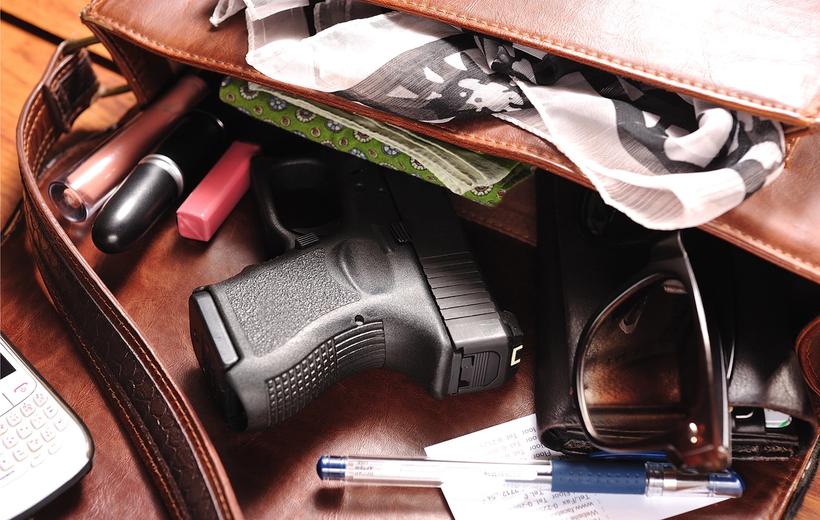
You’ve rushed through the door with your second-grader in tow and an arm full of groceries. You set the groceries on the counter, just as the phone rings with a call from your kid’s teacher. You know there was a problem at school, dinner needs to be started, and your second-grader is throwing a fit. All of this is going on, the pressure’s building, and you just want to get on with it, so you know what you do? You let the groceries sit on the counter. You let the call go to voice mail. And you let your second-grader go on with his meltdown because you are going to do the right thing and lock up that gun in your purse before anything else gets done.
You’ve arrived home from work and want to change clothes and get rid of the belt and holster you’ve been wearing all day with your carry firearm. Where is the gun’s muzzle pointed as you remove the loaded gun from the holster? Be conscious of walls, ceilings, and floors that have people and pets behind, above and below them. Depending on your setup, the garage with a solid cement floor might be the safest place to divest yourself of the gun you carry all day before you secure it elsewhere.
Starting to see the thought path? You would never back out of your driveway without looking in the rearview mirror or taking in the view from your backup camera. In the same vein, assessing which rooms your family members are in before you remove your holstered carry gun is your firearm safety “rearview mirror.” When you first bring a firearm into your home, you will need to think about this every day as you come and go and handle that gun. Do that enough times and you will begin to automatically put the safe handling of your firearm first. Always. That is something that everyone can certainly, literally, live with.